

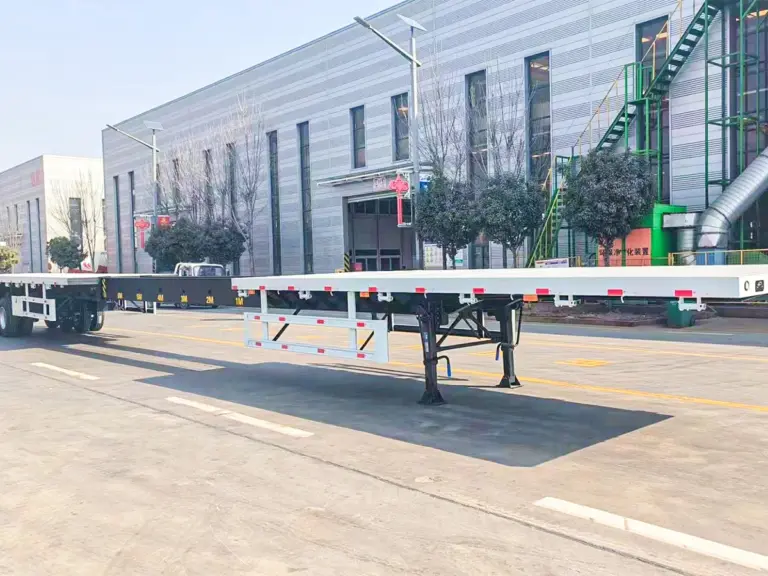
Custom Semi Trailers: How to Spec Special Builds from the Factory
Most semi-trailer catalogs are built around a simple assumption: average cargo, average roads, average regulations. If your operation runs standard container runs between paved ports, that assumption works. But the moment your cargo is irregular, your routes are mining corridors, or your local axle-load rules cap out where the catalog spec sheet begins, a custom semi trailer stops being a luxury and becomes the only unit that survives your duty cycle.
Here’s the good news: Chinese semi-trailer factories treat building to spec as a core part of their business model, rather than an exception. This guide covers what can realistically be customized, how to write a spec sheet that gets you accurate quotes quickly, and how OEM, ODM and full-custom builds actually differ — so your next order turns out to be exactly the trailer you sketched on the whiteboard.
What “Custom” Actually Covers
Customization is not just painting your logo on the side wall. At factory level, a custom semi trailer rebuilds the engineering decisions underneath the steel:
| Decision Point | Standard Build | Custom Build |
|---|---|---|
| Axle configuration | Fixed 2/3-axle layouts | 4 to 7 axles, spread-axle spacing, extendable frames |
| Loading equipment | Basic ladder or ramps | Automatic ladders, hydraulic ladders, reinforced loading ramps |
| Floor and wall steel | Single thickness option | 3–8 mm floor options, side-wall or fence conversions, detachable goosenecks |
| Suspension | Mechanical (leaf) default | Air suspension, heavy-duty mechanical for rough corridors |
| Dimensions | Catalog lengths | Stretched or telescopic decks for wind blades, steel beams, pipe loads |
| Compliance package | Generic export spec | Destination-country lighting, marking, coupling and brake requirements |
Every one of those rows is a decision the factory can engineering-change on request. The question is never “can it be built” — it is whether your spec sheet communicates the requirement precisely enough to quote and build without three rounds of clarification emails.
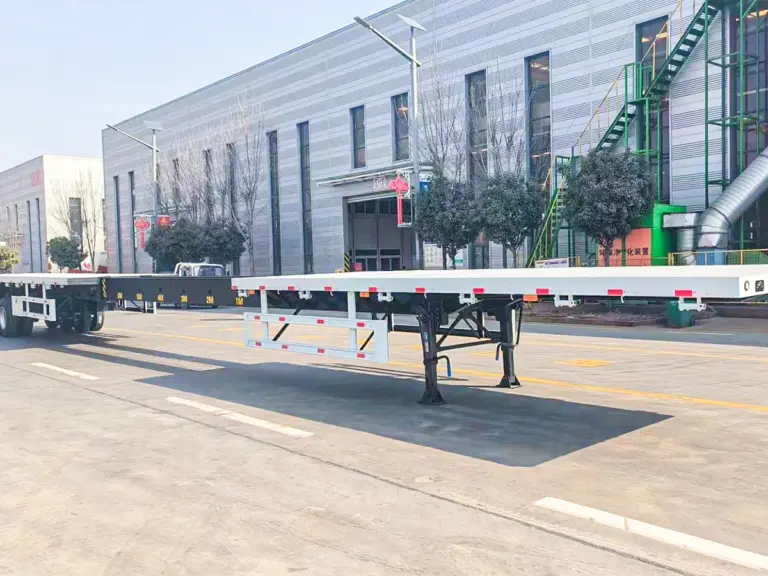
Specialty Builds Real Fleets Are Ordering
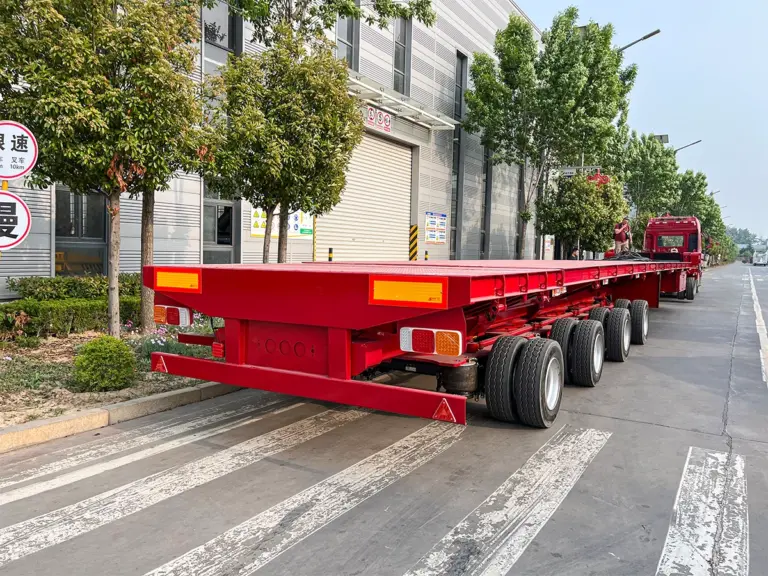
Three specialty categories dominate custom orders out of Chinese factories right now, and each one shows how far a build can move from the catalog:
- Wind Blade & Oversized Energy Equipment Transport. A wind blade transport trailer telescopes from a compact transport length to a working length beyond 40 m, with steering axles that track the tractor around mountain curves. No standard deck does this; every unit is a purpose-built engineering job.
- Extendable Flatbeds for Steel & Structural Haulage. An extendable flatbed semi trailer covers two load cases in one unit: closed length for regional runs, stretched length for beams, pipes and precast sections. The telescoping section, locking positions and reinforcement are all spec’d per order.
- Modular Heavy-Duty Lowbeds for Mining & Plant Moves. A hydraulic modular trailer platform lets operators combine spine and platform modules to match transformer, excavator or generator cargo — capacity class, deck height and gooseneck style are configured to the project, not the catalog.
Notice the pattern: in each category the “product” is really a configurable platform. Your order defines the final machine.
How to Write a Spec Sheet Factories Quote Fast
Factories prioritize RFQs they can price in one pass. A spec sheet that wins fast quotes contains seven blocks:
- Cargo Profile & Load Distribution — what you haul, its density, and where the weight concentrates on the deck.
- Gross & Per-Axle Load Targets — payload plus tare per axle, set against the strictest limits on your routes.
- Route Conditions — road surface, bridge class, gradient, and typical operating speed.
- Dimensional Envelope — legal max length/width/height and dock or pit loading-height limits.
- Feature Requirements — ladder type, ramps, side walls, twist locks, container positions, gooseneck style.
- Compliance package — coupling size (50/90 mm kingpin), brake valve preferences, lighting and reflective marking rules for the destination market.
- Component brands — axle, suspension, brake and valve brand classes you accept, and where substitutes are negotiable.
Send that as a one-page sheet with sketches where words fail. No engineering desk on your side? Hand those seven blocks to our team via the inquiry form and we will build the drawing for you — most custom inquiries come to us exactly this way. The factory’s engineering team responds with a drawing for confirmation — that drawing, once you sign it, becomes the build reference for production and final inspection.
OEM, ODM, or Full Custom: Which Model Fits Your Order?
Buyers throw these terms around loosely, and misusing them causes mismatched expectations:
- OEM build — the factory manufactures to your engineering drawings. You own the design; the factory owns the welding. Highest control, longest lead-in, typically for fleets with in-house engineering.
- ODM build — the factory’s engineers adapt their existing platform to your duty cycle. You specify requirements; they produce the drawings. This is the sweet spot for most African fleet orders: proven chassis bones, purpose-built configuration. When GSC-era buyers search “semi trailer ODM”, this cooperation model — requirement in, adapted platform out — is what they are describing.
- Full custom — a genuinely new trailer type outside existing platforms. Real engineering project, real NRE costs, justified only when nothing on the market does the job.
Most orders that start as “full custom” land as ODM once the factory shows how close an existing platform already is. That is usually good news: platform-based customs carry over crash-tested structures and spare parts availability.
From Signed Drawing to Delivery: Proofing and Quality Control
A custom order is only as good as its checkpoints. Insist on this sequence:
- Drawing Approval Before Production — sign off on dimensioned drawings before any steel is cut; changes afterward cost money and delay delivery.
- Material & Brand Specification in Writing — quoted steel grades and component brands documented, with substitutions allowed only by agreement.
- In-Production Photo Reports — dated photos at frame welding, axle installation, and floor decking stages, as standard practice for legitimate custom builders.
- Pre-Shipment Inspection — dimensions verified against the signed drawing, load test where applicable, plus brake, lighting, surface finish, and marking checks.
- Spare Parts & Documentation Pack — axle/suspension/valve part numbers, wiring diagram, and as-built drawing, which your maintenance team will need in year three.
Third-party inspection (SGS, Bureau Veritas, TÜV) at the factory gate is inexpensive relative to the cargo value these trailers carry, and every serious factory accepts it without friction.
What Customization Costs: Budget and Lead Time Reality
Honest numbers make better decisions than optimistic ones:
- Premium. A configured platform build typically prices 10–25% over the equivalent standard unit; a genuine full custom carries engineering and tooling costs on top.
- Lead time. Standard units ship in roughly two to three weeks from order. Custom builds run three to six weeks depending on engineering depth — telescopic and steering-axle builds sit at the upper end.
- Reorder economics. The first unit absorbs drawing and fixture work. Repeat orders of the same signed drawing drop back toward standard pricing and lead times — one more reason to nail the spec before the first cut.
The premium buys back its cost the first time the trailer finishes a route a standard unit could not run at all.
Frequently Asked Questions
Can I order just one custom semi trailer, or is there a minimum?
Platform-based customs (ODM builds) are quoted per unit — one trailer is a normal order. Genuine full-custom projects may carry minimums because engineering costs amortize across the batch.
Will a Custom-Built Trailer Pass Registration in My Country?
Yes, when the compliance package is specified before the build. Put your destination market’s lighting, marking, coupling and brake requirements into the spec sheet, and the factory engineers the unit to pass — that is precisely what the compliance block in your RFQ is for.
How do I know the factory can actually build what I sketched?
Request references from similar custom builds—drawings, photos of past orders during production, and the factory’s standard QC workflow. A manufacturer that handles custom orders regularly will provide all three without hesitation. You can also browse the product platforms to see which base models your build can start from.
The difference between a trailer that plies your corridor for a decade and one that cracks in year two is usually decided on paper, in the spec stage — not in the workshop. Write the spec sheet properly, choose the cooperation model that matches your engineering depth, and hold the factory to the checkpoints. Custom does not mean complicated; it means specified.
Related Reading
- Buying Semi‑Trailers for African Fleets: Stop Judging Only by Unit Price
- Why 40ft Skeleton Semi‑Trailers Are Popular for African Container Logistics
Ready to price your custom build? Send your cargo profile, target payload and route conditions to the Vehicle Master engineering desk through the online inquiry form or WhatsApp +86 166 6658 9022 (email: [email protected]). You get back a configuration drawing and a firm quotation — not a catalog PDF — typically within 48 hours.