

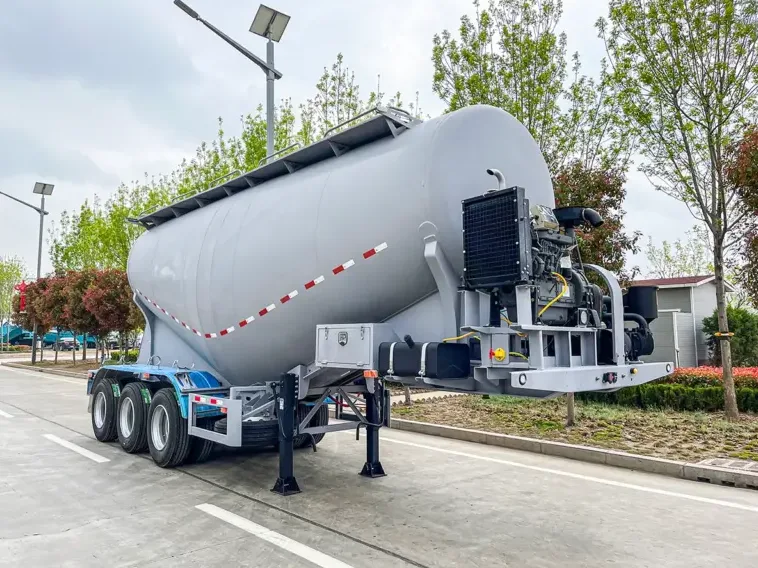
Cement Tanker Semi Trailers: Matching CBM to the Route
When a fleet owner asks us to quote a cement tanker semi trailer, the first question back from our engineering team is never about price. It is a single number: how many CBM? The tank size you pick determines everything downstream: how many axles the chassis needs, how much weight it carries empty, how long it takes to empty at the silo, and ultimately whether the truck turns a profit on your route or loses money. A 60 CBM tanker squeezing through urban streets on short deliveries is no more sensible than a 30 CBM unit spending its day shuttling between plant and silo 400 km apart.
This guide breaks down the four capacity classes VEHICLE MASTER builds, 30, 35, 45 and 60-70 CBM, and shows how each one maps to a specific transport job across African and Middle Eastern markets. If you are new to dry bulk powder trailers in general, start with our powder tanker semi trailer buying guide, then come back here for the capacity decision.
Why Tank Size Dictates the Rest of the Spec Sheet
Bulk cement weighs roughly 1.0-1.2 tonnes per cubic meter when loaded. Multiply the tank volume by that figure and you get the payload, which sets the axle count:
- 30–35 CBM (33–40 t class): 2–3 axles at 13 t is plenty
- 45 CBM: stays at 3 axles, but moves up to 13/16 t to keep per-axle loads legal
- 60–70 CBM: 3–4 × 16 t heavy-duty axles with reinforced suspension as standard
Get the CBM wrong and the rest of the spec collapses: either you haul air because the tank is too small for the silo batch, or you overload axles because the tank is too big for the chassis underneath it. Volume also picks the tank shape. W-shape tanks maximize cubic capacity on a given deck length; V-shape tanks trade a little volume for faster discharge and less residue left in the cone after unloading.
The Four Capacity Classes
Every cement tanker semi trailer in our powder tanker line uses the same proven discharge hardware, a Bohai 12 CBM/min air compressor driven by a Weichai diesel engine, so the real difference between models is where each capacity class earns its keep.
| Capacity | Axles | Tank shape | Best fit |
|---|---|---|---|
| 30 CBM | 2 / 3 x 13T | Compact, short wheelbase | Tight sites, small batching plants |
| 35 CBM | 3 x 13T | V / W shape | Regional distribution |
| 45 CBM | 3 x 13/16T | V / W shape, dual alloy | Mixed powder fleets, weight-limited roads |
| 60-70 CBM | 3 / 4 x 16T | V shape | Long-haul plant-to-silo corridors |
30 CBM: The Site Access Specialist
The 30CBM cement tanker trailer is the compact option for small batching plants and crowded construction sites. With a shorter wheelbase, it rotates in yards that a full 13-meter rig simply cannot enter, and its pneumatic system unloads straight into the silo — no transfer station in between. Local weight laws permitting, the 2-axle model shaves both price and empty weight even further, while the 3-axle frame accepts the larger optional tank. For contractors already running tippers who want to break into cement logistics, it is the lowest-cost way into dry bulk hauling.
35 CBM: The Regional Workhorse
The 35CBM bulk cement tanker trailer is the middle of the range and the most common regional distributor build in East and West Africa. On 3 x 13T axles it balances payload against maneuverability on mixed roads, and the linear intake pipe arrangement keeps unloading smooth at the receiving silo. If your operation feeds several batching stations within a 150-250 km radius and axle law caps you near 40 t gross, this is the default answer.
45 CBM: More Payload, Less Empty Weight
The 45CBM bulk cement tanker trailer attacks the problem from the other end: high strength wear-resistant steel and a dual alloy structure cut tare weight, so more of every legal gross ton is paying cargo. That matters on weight-enforced corridors and for fleets that also haul flour, fly ash or lime powder, since the same tank, in a food-grade or industrial configuration, covers all three. V or W shape, 1 or 2 compartments, and diesel or electric power take-off are all selectable on this platform.
60-70 CBM V Shape: The Corridor Volume King
The 60-70CBM V shape cement tanker trailer exists for one job: moving the maximum cubic meters per trip on long plant-to-silo corridors. The V-shaped tank funnels powder straight to the discharge line, which cuts unloading time and residue versus a W tank at the same volume. Riding on three or four 16-ton axles with a reinforced suspension, this is the unit for cement distribution contracts — the kind where every extra cubic meter on each run is revenue already on the books. The trade-off is equally straightforward: it needs room to swing around, a silo rated for fast discharge, and roads built for its gross weight.
Tank Material and the Discharge System
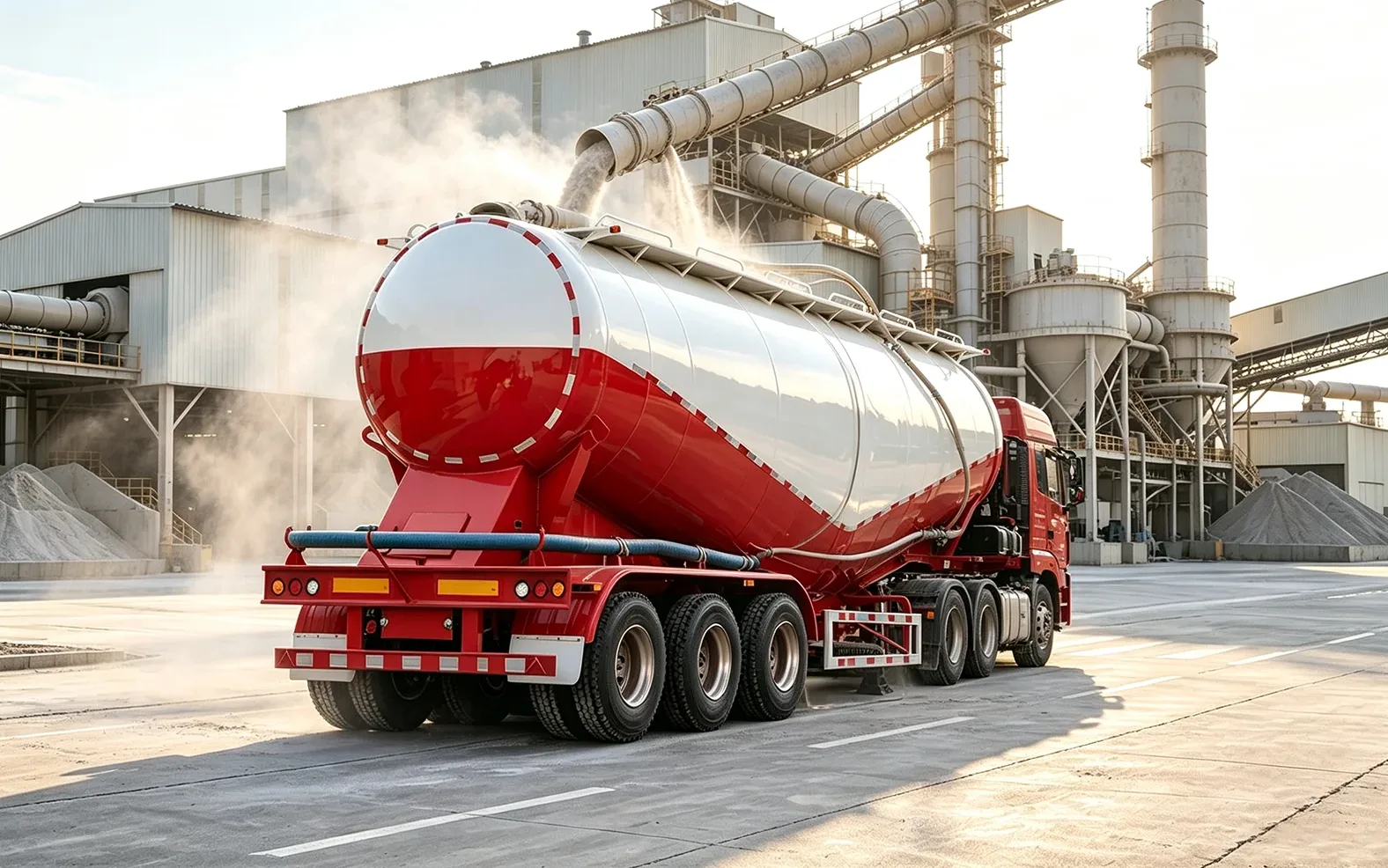
Whichever class you choose, the tank shell comes in carbon steel, aluminum, or stainless steel. Carbon steel is the cost-effective default for cement and fly ash. Aluminum cuts roughly a tonne off the empty weight — worth it on routes where every kilo counts. Stainless steel is the answer for corrosive powders and food-grade flour work. Plate thickness starts at 4–5 mm on the shell and 5–6 mm on the dished ends, every weld goes through X-ray inspection, and the fluidized bed is a wide-area design with a steep tank angle — so the powder flows out cleanly instead of caking in the cone.
Discharge hardware matters more than most buyers expect, because unloading time is billable time at the silo. The standard Bohai 12 CBM/min compressor and Weichai 4102 power unit empty a 45 CBM tank well inside an hour; the diesel or electric option should follow your site infrastructure, not the factory default. Fuel-delivery tankers share the same chassis philosophy but a completely different tank build, so if your contract mix includes liquids as well, read our liquid tanker semi trailer guide before speccing a two-trailer order.
Three Questions Before You Order
- What will the route permit? Bridge limits, legal axle loads, and the receiving silo’s turning circle rule out whole capacity tiers before price enters the discussion.
- How long is each run? Under 150 km with multiple drops points to 30–35 CBM; a single 250+ km plant-to-depot shuttle makes 45 and 60–70 CBM units pay.
- What does the silo accept? Discharge height and distance, plus how fast the site can receive, decide whether a V shape fast-discharge tank pays for itself.
Answer those three and the CBM choice makes itself. Send your route profile, target payload and local axle regulations through our inquiry form, and our engineers will return a configuration sheet with the compressor, axle and tank material options that fit, factory-direct, within 24 hours.
Ready to spec your cement tanker? VEHICLE MASTER builds all four capacity classes with 1-unit MOQ, 15-30 day delivery and OEM/ODD/CKD/SKD cooperation models. Get a factory-direct quote via the inquiry form or WhatsApp.