

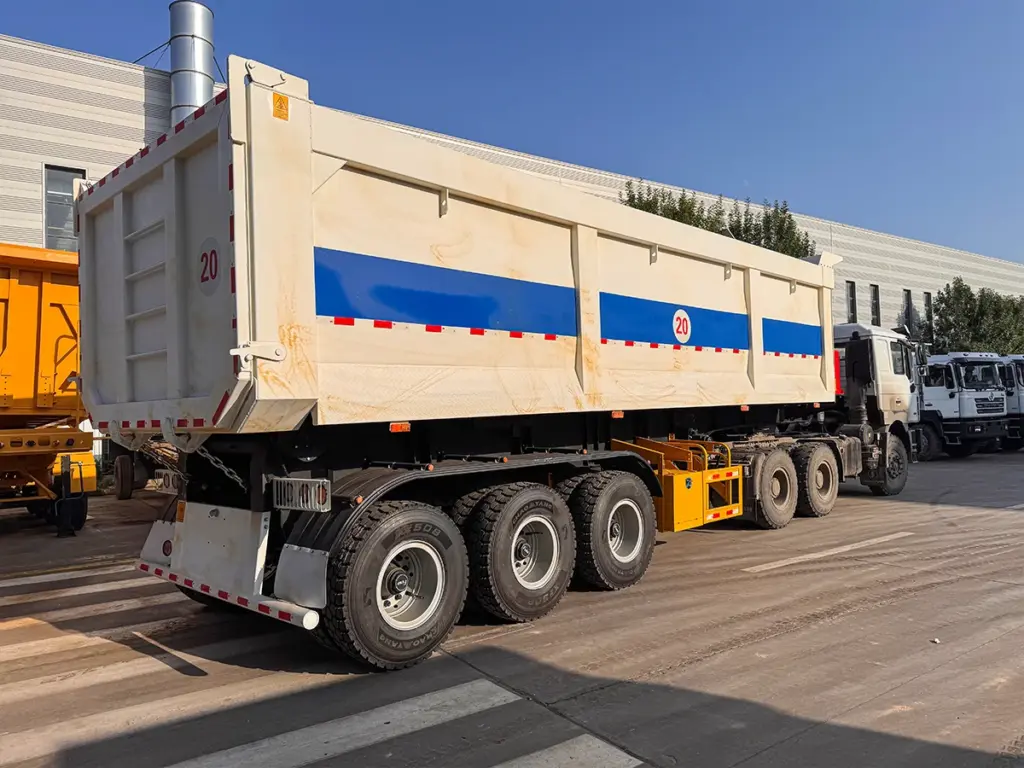
Rear Dump Semi Trailer: Sizes, Ton Ratings and Key Specs
A rear dump semi trailer is the default choice when aggregates, coal, ore or construction rubble have to keep moving on rough African roads. Among all dump trailer types, the rear dump remains the most versatile: simpler body geometry, faster tipping cycles and easier fabrication than side dumpers, at a lower price point — which is exactly why most fleets in Zambia, DRC, Tanzania and West Africa standardize on it.
This guide breaks down how rear dumps work, which ton rating fits which operation, what separates a square box heavy end dump from a standard rectangular body, and which chassis details decide whether your trailer survives five years of mine haulage. You can also see the full model range on the rear dump semi trailer product page.
How a Rear Dump Semi Trailer Works
Every rear dump tips its cargo backward using one of three hydraulic lifting mechanisms, and the mechanism choice matters more than most buyers realize:
- T-type (Mallory type) — a single large cylinder mounted under the front of the box. High lifting force, proven design, the most common layout for 60–100 ton heavy units.
- F-type (single cylinder floating connecting rod) — the cylinder works through a linkage, which shortens the cylinder and reduces side loading on the ram. A good middle ground for 30–60 ton bodies.
- Front direct top type — the cylinder pushes straight up from the gooseneck area. Simple and fast, typically paired with shorter boxes.
Whatever the layout, cylinder quality dominates the ownership experience. Reputable brands such as HYVA — with the cylinder model matched to the cargo box length — carry heavier loads through more tipping cycles before seals start weeping. On a trailer doing 40+ tipping cycles a day at a mine, a cheap cylinder is the single most expensive saving you can make.
Sizes and Ton Ratings: Which One Fits Your Operation
Rear dumps scale from light construction work to full mining duty. The table below maps the common configurations against typical use cases:
| Configuration | Axles | Typical payload | Best suited for |
|---|---|---|---|
| 30 ton tipper semi trailer | 2–3 | 30 T | City construction, sand and gravel supply |
| 3 axle 50 ton rear dump | 3 | 50 T | Regional aggregate haulage, quarry-to-site |
| 3 axle 60 ton tipper | 3 | 60 T | Coal and ore concentrate on mixed roads |
| 80 ton end dump | 3–4 | 80 T | Mine haulage, square box heavy duty |
| 100 ton dump semi trailer | 4 | 100 T | Short-haul mine pit duty, high-density ore |
Two practical rules apply when picking a rating. First, match the payload to what your tractor can actually pull loaded on grades — an 80 ton box pulled by an underpowered unit just burns clutches. Second, respect local axle-load enforcement: in stricter corridors a 4-axle 100 ton unit may face fines that erase its capacity advantage, while on private mine roads the same trailer is ideal.
The Square Box 80 Ton End Dump: Built for Mining Duty
Around heavy mining operations, one configuration keeps coming up in searches and inquiries: the square box 80 ton end dump. Its cargo body is built with wear-resistant reinforced steel plate — typically 5 mm floor and 4 mm walls — in a square-box profile that maximizes volume for dense, abrasive loads like ore, crushed stone and slag.
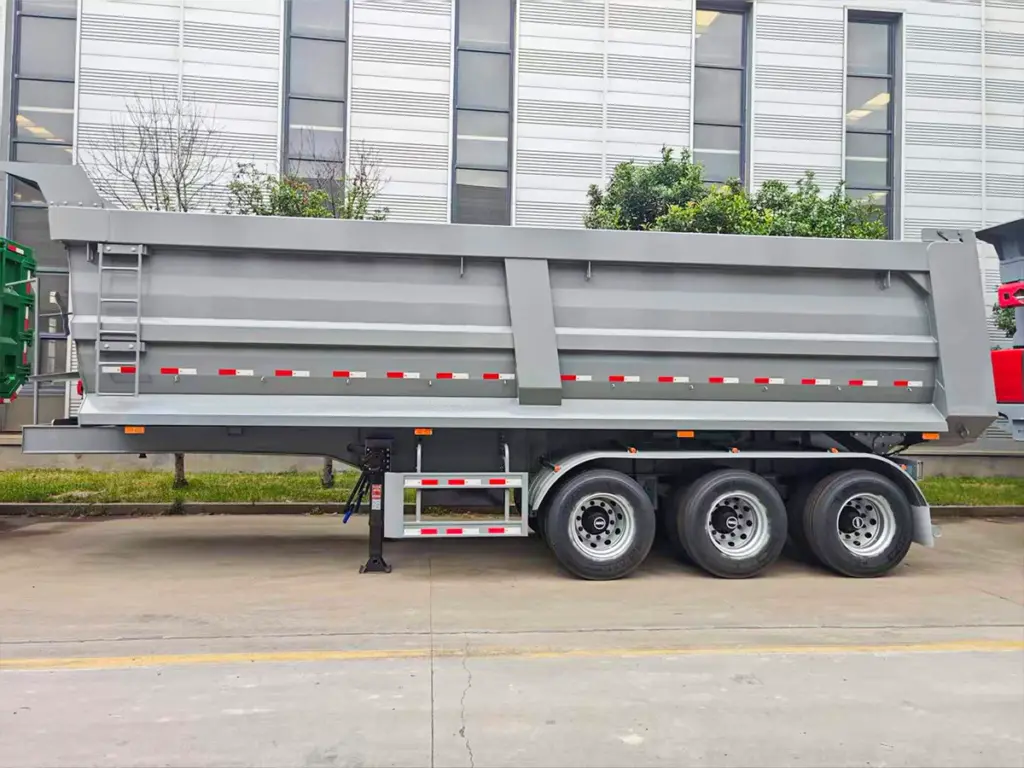
Compared with a rectangular or round body, the square box trades a little tare-weight efficiency for three mining-critical advantages: larger volume for low-density loads, straighter walls that resist bowing when struck by loader buckets, and easier replacement of wear plates. Fleets hauling high-density ore sometimes prefer the round body instead, because its geometry sheds material cleanly and tolerates impact better — a reminder that body shape should follow your material, not the other way around.
Chassis and Body Build Specs Worth Checking
The difference between a rear dump that lasts and one that cracks at 18 months hides in the chassis details. On a standard heavy-duty unit — roughly 11,000 × 2,500 × 2,800 mm — check the following against the supplier’s spec sheet:
- Main beam steel: Q345B or T700 high-strength steel, with a beam height around 500 mm and plate thickness in the 14 / 8 / 16 mm range (upper / middle / lower). Thinner plates on a 60+ ton unit are a red flag.
- Cargo body: 5 mm floor with 4 mm walls as a mining baseline; reinforced ribs on the floor and sides to stop oil-canning under impact loading.
- Axles: 13T or 16T axles from FUWA, BPW or equivalent, 2–4 depending on rating, with 11.00R20 or 12R22.5 tires matched to axle count.
- Front axle lifting: available on most configurations — it saves tires and brakes on empty return legs.
- Landing gear and king pin: 28-ton two-speed landing gear and a 3.5-inch JOST-pattern king pin for heavy units.
Field Tips for African Fleet Operators
Beyond the spec sheet, four field considerations decide total cost per ton:
- Brake system spec. Loaded descents into pits and escarpment roads punish marginal brakes — spec for reliability, not just compliance, and read our guide to semi-trailer brake systems on African routes before signing.
- Lifting stability. Ask the supplier about the tipping stability envelope — a box that feels nervous at half-raised angle with mixed loads will eventually bend a frame.
- Seals and cylinder spares. Confirm parts availability for the exact cylinder model; a week of downtime waiting for a seal kit costs more than the price difference between cylinder brands.
- Total operation context. Dump demand tracks construction and mining cycles — the trends we mapped in our Africa tipper market analysis still point to multi-axle heavy units as the growth segment, and maintenance discipline (see our service life extension guide) keeps them earning longer.
Frequently Asked Questions
Q1:What is the difference between a rear dump and a side dump semi trailer?
A:A rear dump tips backward in one motion and needs headroom behind the trailer, while a side dump empties laterally and works where rear clearance is tight. Rear dumps are simpler, cheaper and faster for stockpile loading; side dumps suit tunnel work and rail-side unloading.
Q2:How many tons can a rear dump semi trailer carry?
A:Standard configurations run from 30 to 100 tons. The sweet spot for most African aggregate and coal operations is the 50–60 ton three-axle class; mining duty moves to 80–100 ton units.
Q3:Square box or round body — which is better?
A:Square box bodies carry more volume and take loader impact better, suiting mining and quarry work. Round bodies shed sticky material cleanly and handle high-density loads well. Match the body to your dominant material.
Conclusion
A rear dump semi trailer is a straightforward machine, but the ton rating, lifting mechanism and body construction decisions interact — and getting them right is what turns a trailer into a profit center. Define your material and route first, then match the configuration to it. For current specifications and pricing across the full 30–100 ton range, visit the rear dump semi trailer product page or contact the Vehicle Master team directly.