

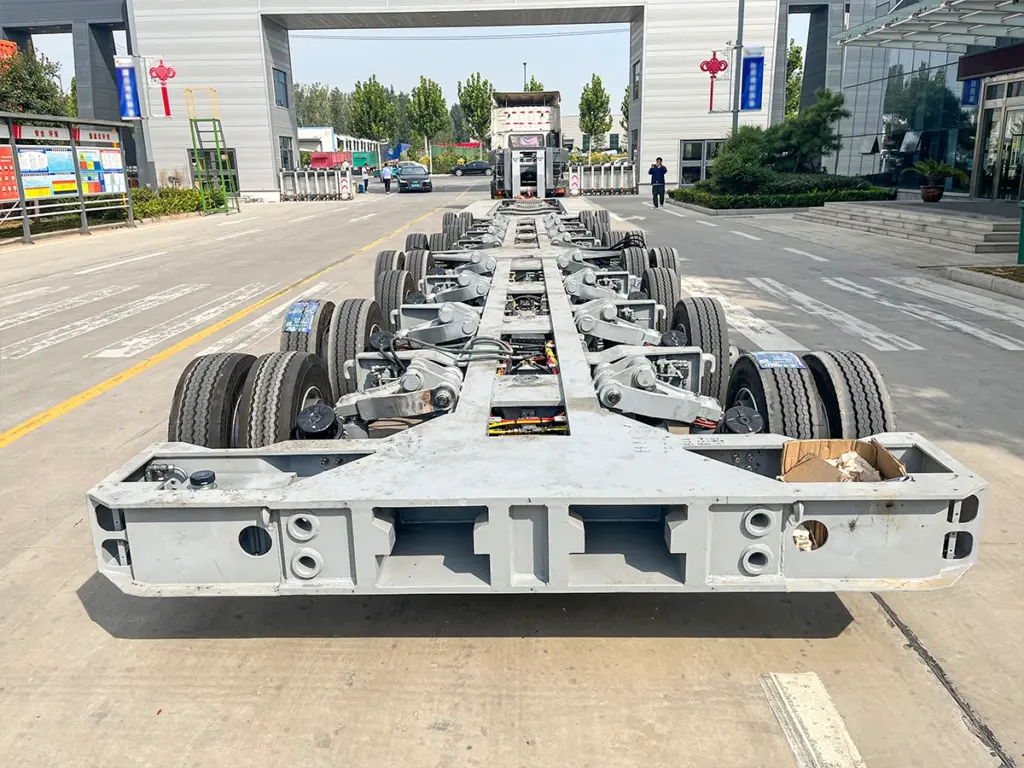
Multi-Axle Lowbed Trailers: Africa’s Mining Haulage Shift
African buyers’ search behaviour for heavy transport machinery has evolved. In the last three months, our sales team has seen a clear shift in incoming searches and inquiries: demand is moving away from conventional 3-axle trailers and toward multi-axle lowbed semi-trailer setups. Buyers are now asking more frequently for 4-axle, 6-axle and even 7-axle lowbed models. They also tend to prefer hydraulic ramps and auto ladders instead of simple spring-type versions.That pattern is worth reading closely, because it tracks a real change in what African mines and contractors are asking their trailers to do.
Where the Demand Is Coming From
Three demand pools are driving the upgrade cycle.
The Copper Belt in Zambia and the DRC. Mines here are expanding processing infrastructure and scaling up mine operations. Every excavator, loader and mill component delivered across the border must be hauled on trailers approved for regional road travel. Buyers from these two markets now regularly send enquiries for trailers with an 80-ton or higher payload — for loads of this magnitude, 3-axle trailers are no longer practical.
West African gold and construction. Contracting fleets in Ghana and surrounding markets are consolidating trips: one well-specified multi-axle lowbed semi trailer moving a 60-ton class machine beats two standard trailers moving it in pieces, both in cost per tonne-kilometre and in crew time.
Infrastructure programmes. Road, dam and power projects across East Africa are importing plant machinery at a pace that outstrips the local fleet’s carrying capacity, pushing project logisticians toward rented or purchased multi-axle capacity for the construction window.
What Buyers Are Now Specifying
The search data itself tells the story. The fastest-growing specification phrases in our enquiry stream are concrete features, not generic model names:
- Axle count as the headline spec — 4 axle lowbed semi trailer, 6 axle lowbed semi trailer manufacturer, 7 axle lowbed semi trailer now outnumber generic lowbed trailer searches in our data.
- Automatic & hydraulic ramps for lowbed trailers — 4 axle lowbed semi trailers fitted with automatic ramps and hydraulic ramp lowbed semi trailers are growing in popularity. For teams that load and unload heavy machinery every day (rather than only on occasion), traditional spring-loaded ramps are no longer sufficient.
- Sidewalls and protection — requests for 4 axle lowbed semi trailer with sidewall reflect mixed duty: machinery one week, bagged consumables and mine supplies the next.
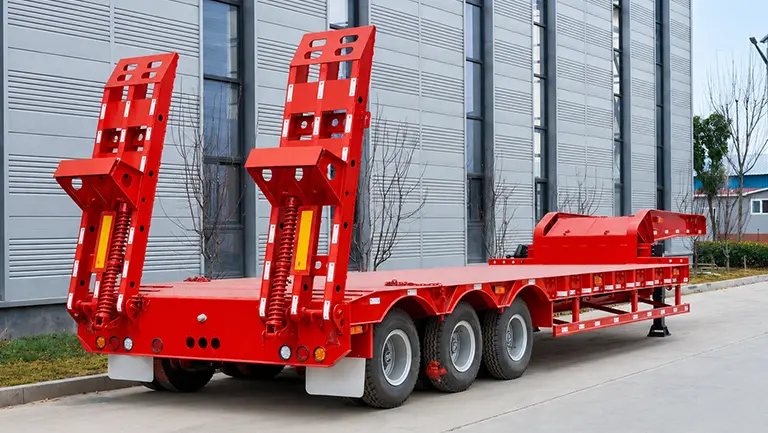
The pattern repeats inside our own lineup pages — the 4-axle lowbed semi trailer and 3-axle 60-ton lowbed pages draw steady traffic, but the fastest-improving page is the multi-axle category itself.
Why the Extra Axles Pay for Themselves
More axles are not a luxury purchase; they are how a fleet stays legal and profitable at the same time.
Local highway regulations set maximum load limits for each axle group along regional routes. Spreading the weight of an 80-ton machine across six to seven axles keeps each axle within the legal cap, preventing fines and bridge damage claims caused by overloaded 3-axle semi trailers.
For gravel mine haulage, lighter per-axle loads significantly slow tyre wear. Tyres are a major running cost in African freight transport, and multi-axle setups effectively extend tyre lifespan on rough road surfaces.
There is also the stability argument: a long deck on more, smaller axle groups rides rough roads with less pitching, which protects both the machine being carried and the trailer’s own structure. For buyers weighing fixed-gooseneck versus detachable options at these weights, our earlier comparison — Fixed vs Detachable Gooseneck Lowbed Trailer — still holds, but the detachable gooseneck case gets stronger as payloads climb.
What the Shift Means for Your Next Order
Three practical implications for fleet buyers and traders planning the next 12 months:
Order against the machine, not the average load. Specifying the heaviest machine on the contract — not the fleet average — is what determines axle count. A trailer sized for the average load will be overloaded on its first difficult week.
Consider modular platforms for uncertain contracts. The modular heavy-duty lowbed platform exists precisely for fleets whose contracts swing between 60-ton and 150-ton duties; axle sections can be added as the machine park grows.
Budget the loading system, not just the trailer. Automatic and hydraulic ramps raise initial purchase costs, yet they boost daily workflow speed, reduce required staff and lower safety risks — this is why buyers specifically search for these features.
The underlying demand story is the one we outlined in Why Lowbed Semi-Trailer Demand Is Booming — what has changed is the specification bar. The full multi-axle range, from 4-axle workhorses to 7-axle heavy haulers, is on the multi-axle lowbed product page; bring your heaviest machine’s weight and dims, and the axle count follows.