

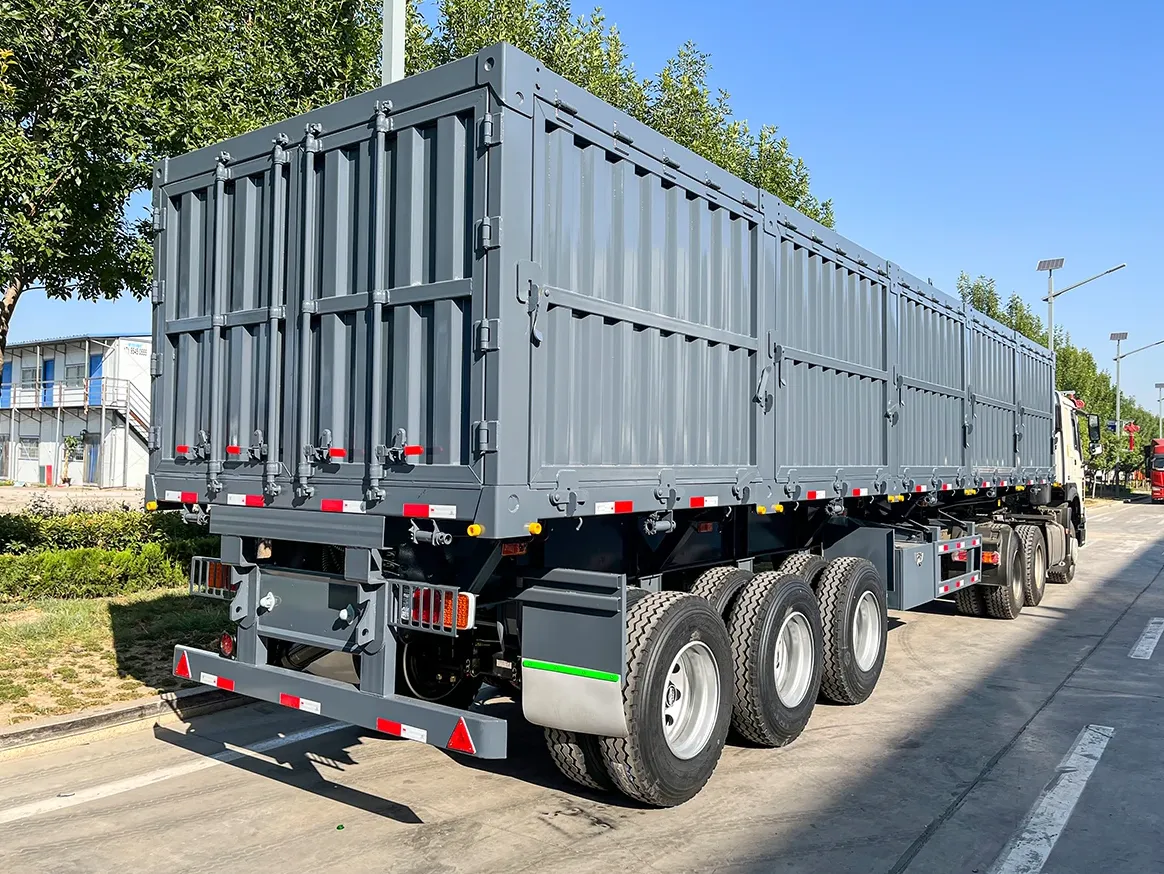
Side Dump Semi Trailers: Why African Mine Sites Are Switching to Side Tipping
Across most African bulk corridors, the end-dump rear tipper remains the default haulage workhorse. Operators know it inside out, it holds its value on the resale market, and as long as there is a tipping wall to back up to, it gets the job done.But over recent buying seasons a different enquiry pattern has been building at our factory: mine fleets asking for a side dump semi trailer for pits, process yards and haul roads where rear tipping itself is the bottleneck.
This article breaks down the site conditions that justify side tipping, the cost lines where it quietly wins, and the spec details that separate a durable side tipper from a fragile one.
How Side Tipping Changes the Unloading Math
A side dump unloads by tipping its cargo box to the left or right — no repositioning, no reversing against a wall, no waiting for the truck ahead to clear the pad. Wherever the trailer stands, that is where the material goes. On a haul road with roadside stockpiles, the driver stops, tips, and rolls on.
Just as important is what the geometry does for stability. Because the box tips sideways through a low arc, the centre of gravity stays far lower than on a rear tipper raised to full height. That keeps the whole rig settled on uneven ground — the classic weakness of tall end dumps operating on rough mine pads. Twin HYVA cylinders with a mechanical safety lock hold the box secure in transport, and the low tipping height means crosswinds and soft shoulders are far less dramatic events than they would be with a raised rear box.
What the Site Conditions Dictate
Narrow discharge strips and roadside stockpiles
Many African mine pits and quarry yards simply do not have a wide, engineered tipping pad at the discharge point. If your discharge zone is a strip beside a haul road or a slot between stockpiles, a rear dumper has to align carefully for every pass. A side tipper empties along its own length without moving.
Tacky, damp and abrasive material
Moist ore, clay-coated gravel and wet coal cling to a raised rear dump box instead of sliding out on their own. Drivers end up rocking the bed up and down to shake them loose — burning fuel and wearing the hoist cylinders. A side tipper sheds those same sticky loads at a far lower lift angle, and that practical edge is why coal and mineral haulage fleets keep ordering this setup.
Rough ground and tipping stability
A rear tipper at full lift on ground that is not perfectly level is a stability incident waiting to happen. The wide-span cylinder layout and reinforced frame of a well-built side dump keep the trailer planted even when the discharge area is rough, rutted or freshly cut.
Cycle-time pressure
Where trucks queue at a single tipping wall, every minute of alignment and waiting is tonnage lost. Sites that switched part of their fleet to side tipping typically report the biggest gains not on the road, but at the pile.
Side Dump vs Rear Dump: The Practical Comparison
| Factor | Side dump semi trailer | Rear dump (end tipper) |
|---|---|---|
| Unloading direction | Left or right, alongside the trailer | Rear, into a wall or open pad |
| Repositioning at discharge | None | Align to wall or pad each pass |
| Cycle time in tight yards | Faster | Slower where space is limited |
| Stability while tipping | Low centre of gravity | Full-height lift, level pad needed |
| Ground condition tolerance | Handles rough, uneven discharge areas | Prefers firm, level ground |
| Best-fit material | Sticky, wet ore, aggregate, coal | Free-flowing bulk on open sites |
None of this makes the rear dump obsolete. On wide, engineered sites with free-flowing material, a well-specified rear dumper still moves tonnes at the lowest cost — our rear dump size and ton-rating guide covers that side of the decision. The honest summary: match the tipping geometry to the site, not to habit.
The Spec Sheet: What to Actually Compare
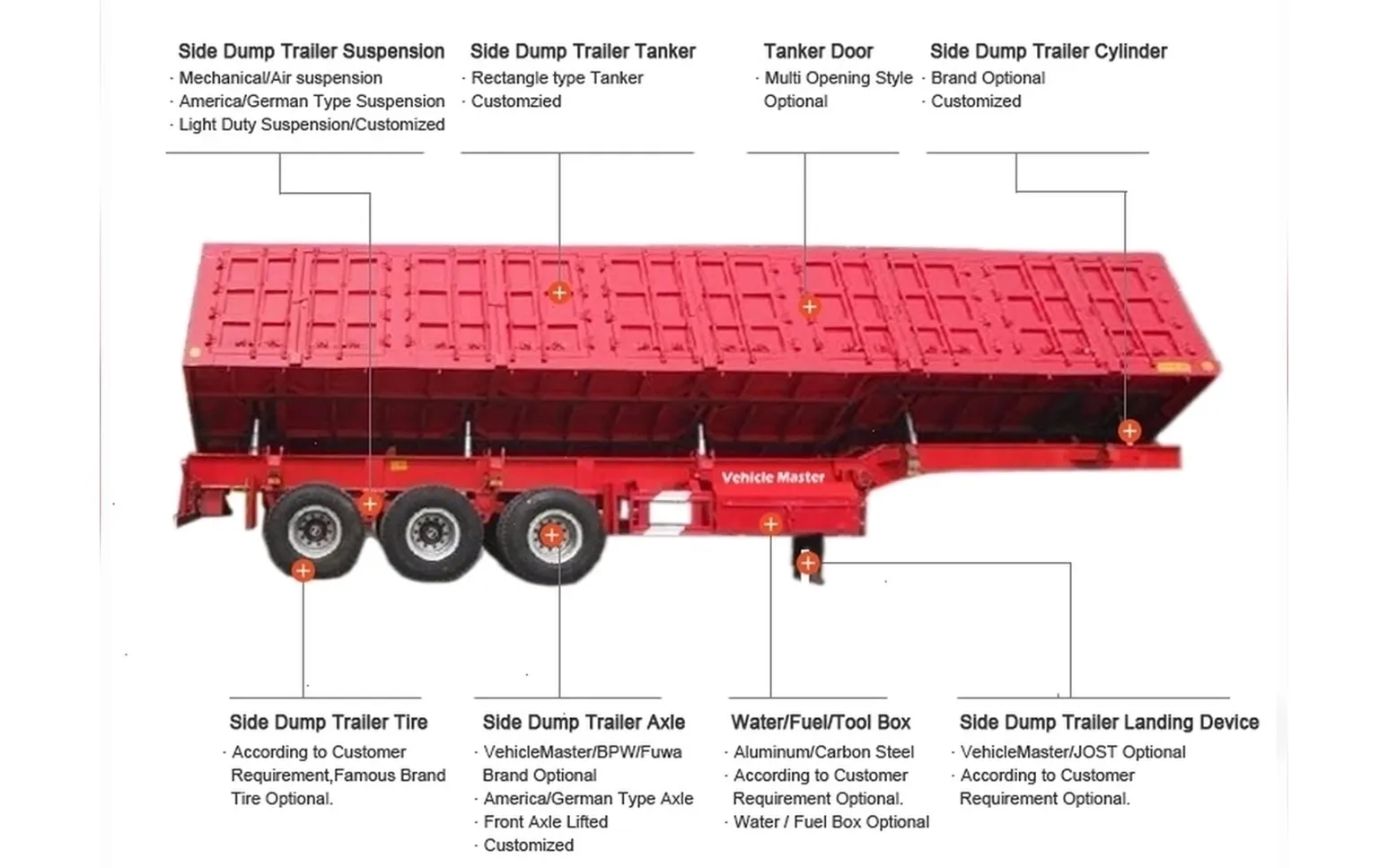
Not every side tipper on the market is built for mine duty. On our own 3-axle side tipper semi trailer, the specification points that matter most are:
- Loading capacity: 30 to 100 tons across 3- and 4-axle configurations — match the rating to your densest material, not your average load.
- Cargo box steel: manganese plate, 5 mm floor and 4 mm sides, bent and welded rather than patch-panelled, for abrasive loads.
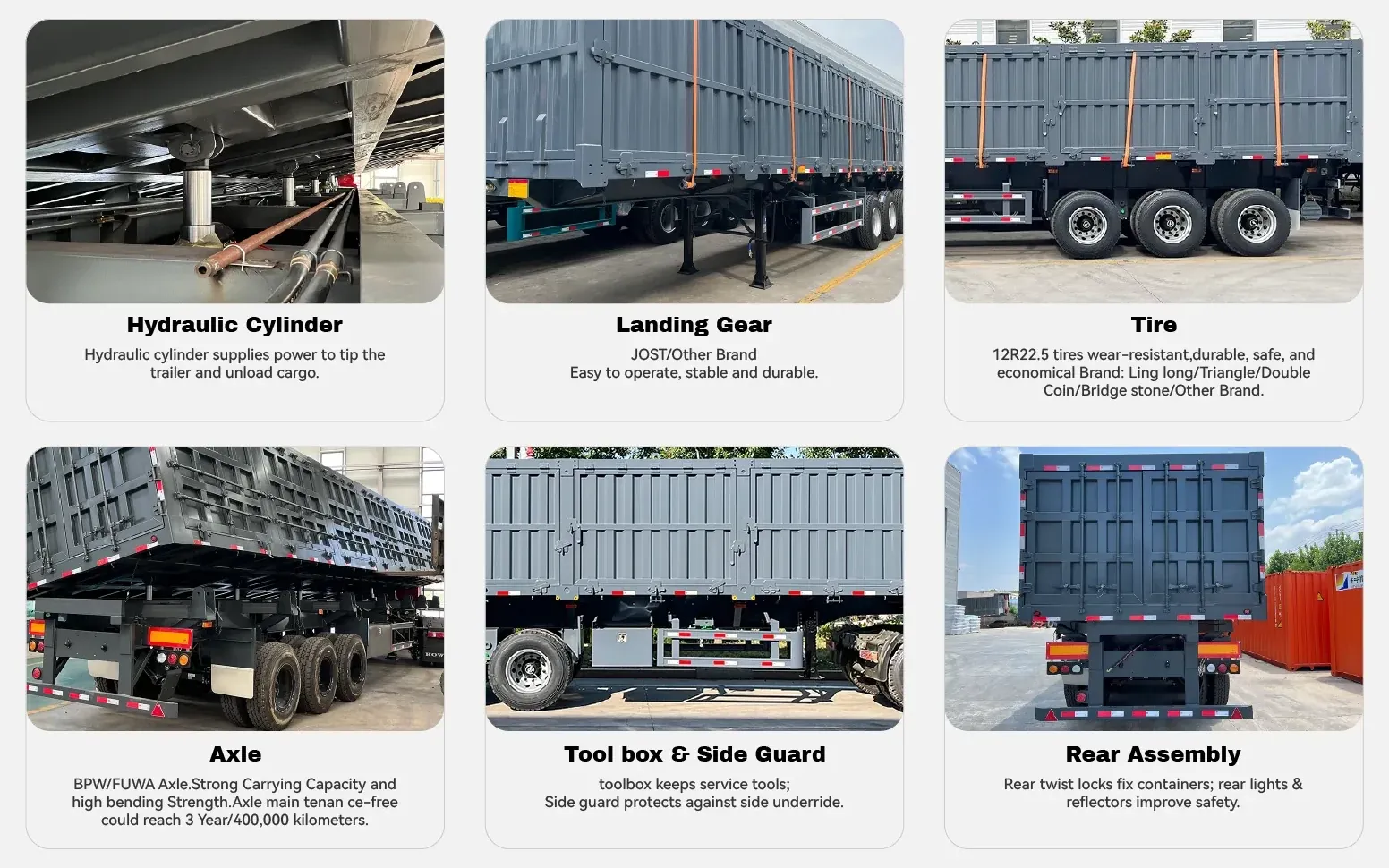
- Lift system: HYVA hydraulic cylinders + a mechanical transport lock — the box stays pinned even when hydraulic pressure drops.
- Landing legs: JOST 28T two-speed legs, over-rated for the hard coupling impacts of mine and quarry yards.
- Axle setup: Optional lifting front axle — an empty trailer rolls on fewer wheels and wears fewer tires.
- Tires: 12R22.5 fitment with brand options from Linglong and Triangle through to Double-Coin and Bridgestone.
The Cost Lines Where Side Tipping Wins
Tonne-kilometre cost is ultimately a cycle-time game. If side tipping cuts five minutes off every discharge and your trucks discharge four times a shift, that is real daily tonnage recovered without adding a single vehicle. Three further cost lines favour the format on the right sites:
- Tire economics: Lift the front axle on empty returns and tire spend drops directly — tires rank in the top three operating costs on African haul routes.
- Cylinder and box life: shedding sticky material at a low angle means fewer full-height shake cycles, so cylinders, pins and box welds all last longer.
- Spillage and cleanup: controlled side placement onto a defined windrow beats scattering material off a high rear lip — less cleanup labour at the pile.
If you are weighing these numbers for a specific route, hand your material density, axle-limit rules and discharge-site layout to our engineers through the inquiry form — a side-versus-rear answer usually comes back within a day.
Where Demand Is Building Across Africa
The enquiries we see are not evenly spread. They cluster where pits are tight and material is difficult: the copperbelt haul roads of Zambia and the DRC, where ore is heavy and discharge strips are narrow; coal corridors, where damp fines cling to a raised box; and quarry process yards feeding crushers that cannot afford aligned-queue delays. The pattern echoes what we documented in the broader tipper market demand study — buyers are specifying for site conditions, not generalities. Heavy plant moving between sites often pairs these trailers with the multi-axle lowbed configurations now common on mining contracts, and contractors running mixed fleets frequently spec an 80-ton end dump alongside side tippers to cover both site types.
FAQ
Why choose a side dump instead of a rear dump?
Side dump unloads to the left or right without moving the truck — ideal for narrow sites, fast unloading cycles and sticky material that will not clear a raised rear box cleanly.
Can it tip sideways safely on rough or uneven ground?
Yes. The wide cylinder spread, low lift height, and reinforced frame hold the body steady throughout the side tilt — even on unpaved or sloped surfaces.
What capacity range is available?
30 to 100 tons, in 3- or 4-axle configurations, with the cargo box and cylinder layout matched to your material density.
Running a tight pit or a sticky-material corridor? Send us your site conditions, material and target payload via the inquiry form, or message us on WhatsApp — our engineers will spec the right side dump semi trailer configuration and quote factory-direct within 24 hours.